


Arches National Park: What to See, Hike & Know Before You Go

Updated: Sep 2
Updated: August 2026

Are you in the middle of planning your Utah national park adventure and can't decide what to do, where to stay, or even what to pack for Arches National Park? Well, you've made it to the right place! I've been lucky enough to visit this totally underrated national park more than three times now, and somehow I still find something new every time we come back.
I've hiked Delicate Arch at sunset twice, explored almost every major stop in the park, and visited during completely different times of year. And after all of those trips, Arches is still a national park I would happily go back to again and again.
There are more than 2,000 natural stone arches here, and there's so much more to see than just Delicate Arch.
In this guide, I'm breaking down everything we've learned from our trips, including our favorite hikes and viewpoints, the best time to visit, where to stay, what to pack, and the things I'd want to know before visiting Arches National Park for the first time.
Here's everything you need to know before visiting Arches National Park!
In this Arches National Park Guide:
Disclaimer: This post may contain affiliate links. If you make a purchase or booking through one of these links, we may earn a small commission at no extra cost to you. We only recommend products, places, and services we trust. Thank you for supporting our work!
Where is Arches National Park?
Arches National Park is located in southeastern Utah, just 5 miles north of Moab. The entrance is right off US-191, so it's incredibly easy to visit if you're already staying in town or road tripping through southern Utah.
Moab is by far the best place to stay when visiting Arches since there are no hotels, restaurants, or gas stations inside the park. Plus, there's so much more to do in the area once you're done exploring the national park. If you're spending a few days here, we have a full guide to the best things to do in Moab, including our favorite places to stay, eat, and explore.
If you're flying in, Canyonlands Regional Airport is the closest airport, located about 11 miles from the park entrance, but flight options are pretty limited. Grand Junction Regional Airport is another option about 109 miles away, while Salt Lake City International Airport is about 230 miles from Arches and usually has the most flight choices.
Getting Around Arches National Park
Arches is honestly one of the easiest national parks to get around. There's only one main entrance and one paved road running through the park, so it's pretty hard to get lost.

There isn't a shuttle system here like there is in Zion, so you'll definitely want your own car. If you're flying into Utah, I recommend renting a car for your trip. The main park road runs about 18 miles from the visitor center all the way to Devils Garden, with turnoffs along the way for places like The Windows, Delicate Arch, Balanced Rock, and other viewpoints and trailheads.
The biggest issue isn't navigating the park, it's actually the parking. Delicate Arch, The Windows, and Devils Garden can get extremely busy, and parking lots can stay full for hours during peak season. We've always had the best luck getting into the park early, and I'd especially recommend doing that if there's a specific hike or sunrise spot you don't want to miss.
One thing I really like about Arches is how much you can see without doing a huge hike. There are overlooks and short trails all along the scenic drive, so even if you're not planning to hike all day, you can still see a ton of the park.
Do You Need Reservations for Arches National Park?

As of 2026, you do not need a timed-entry reservation to visit Arches National Park. You can enter the park at any time during operating hours without booking a specific time slot in advance.
That being said, Arches still gets extremely busy, especially on weekends and during spring and fall. If parking lots or roads get too congested, the park can temporarily limit or divert vehicles, so I still recommend getting there early.
You will still need reservations for certain things inside the park, including Devils Garden Campground and ranger-led or self-guided Fiery Furnace hikes.
Arches National Park Entrance Fees
The standard entrance fee for Arches National Park is $30 per private vehicle, and your pass is valid for 7 consecutive days (make sure to keep your pass or receipt). If you're entering by motorcycle, it's $25, or $15 per person if you're walking or biking into the park.

If Arches is the only national park you're visiting, the regular entrance pass is probably all you need. But if you're planning a Mighty 5 road trip or visiting several national parks within the same year, I'd definitely look into the America the Beautiful Pass instead. For U.S. residents, it's currently $80 for the year and covers entrance fees at more than 2,000 federal recreation sites.
There's also a $55 Southeast Utah Parks Annual Pass for U.S. residents that covers Arches, Canyonlands, Natural Bridges, and Hovenweep for one year, so that can be another good option if most of your trip is focused around southeastern Utah.
Best Time to Visit Arches National Park
I think the best time to visit Arches National Park is during the spring or fall. The temperatures are usually much more comfortable for hiking, and you can spend a lot more of the day outside without dealing with the extreme summer heat.
We've visited Arches during completely different times of year though, and every season has its pros and cons. Here's what I'd expect depending on when you visit.
Spring in Arches National Park
Spring is one of the best times to visit Arches, especially if you want to spend most of your trip hiking. Days start warming up, but you're usually avoiding the extreme heat that comes later in the summer.
The downside is that spring is also a really popular time to visit, so trailheads and parking lots can fill up quickly. I'd plan on starting your days early, especially for hikes like Delicate Arch and Devils Garden.
Summer in Arches National Park

Summer is absolutely doable, but you need to take the heat seriously. There is very little shade throughout most of Arches, and exposed trails can feel brutal in the middle of the day.
If you're visiting during summer, I'd do your longer hikes around sunrise, spend the hottest part of the afternoon driving to viewpoints or taking a break in Moab, and head back into the park later in the day.
And bring WAY more water than you think you'll need. This is not somewhere I'd ever start a hike with one little water bottle.
Fall in Arches National Park
Fall is another one of my favorite times to visit Arches. Temperatures start cooling down again, which makes hiking much more enjoyable, especially once you get into October.
Just like spring, fall is popular, so don't expect to have the park completely to yourself. But if I were planning another trip specifically around hiking, spring or fall would be my first choice.
Winter in Arches National Park

Winter is one of the most underrated times to visit Arches if you don't mind the cold. The park is generally much quieter than it is during spring and fall, and if you get lucky, you may even get to see snow dusting the red rocks.
The tradeoff is that winter weather can be unpredictable. Snow and ice can make some trails slippery, temperatures can drop below freezing, and daylight hours are much shorter, so you'll want to leave some flexibility in your plans.
How Many Days Do You Need in Arches National Park?
I think one full day is enough to see the highlights of Arches National Park, especially if you're mostly interested in the main viewpoints and a few shorter hikes. You can cover a surprising amount of the park in one day since most of the major stops are located along the same scenic road.

That being said, I'd personally give yourself two days if you have the time. It makes the trip feel way less rushed and gives you enough time to do longer hikes like Delicate Arch and Devils Garden without trying to squeeze every single stop into the same day.
If you're only spending one day in Arches, I'd focus on the places you care about most instead of trying to get to every viewpoint. For us, Delicate Arch, The Windows, Double Arch, Balanced Rock, and Devils Garden would be at the top of the list.
And if you're staying in Moab for several days, I wouldn't spend your entire trip inside Arches. Canyonlands National Park, Dead Horse Point, and the rest of the Moab area are absolutely worth saving time for too.
Where to Stay Near Arches National Park
There are no hotels or lodges inside Arches National Park, so almost everyone visiting the park stays in Moab. Since downtown Moab is only a few miles from the park entrance, it's easily the most convenient place to stay.

We've stayed in Moab multiple times now, and our two favorite hotels are WorldMark Moab and Wolfe's Hotel Moab. Both are great options for exploring Arches, especially if you want to be close enough to get into the park early without having a long drive in the morning.
If being close to the park is your biggest priority, look for hotels on the north side of Moab along US-191. If you'd rather be able to walk to restaurants and shops at night, I'd stay closer to downtown instead.
Hotel prices in Moab can get pretty expensive during spring and fall, so I recommend booking as early as possible if you're visiting during peak season. You can find more hotel options below.
Camping in Arches National Park
If you'd rather stay inside the park, Devils Garden Campground is the only campground in Arches National Park. It's located at the very end of the scenic road, so you're already right near some of the park's best hiking trails and viewpoints.
Camping reservations are available for stays between March 1st and October 31st, and I would definitely book as early as possible if you're visiting during this time. The campground is extremely popular and is usually full during peak season. Reservations can be made up to six months in advance.
From November through February, campsites are first-come, first-served instead. Devils Garden has restrooms and running water, but there are no showers, so keep that in mind if you're planning to camp for multiple nights.
If Devils Garden is full, there are also plenty of campgrounds around Moab, including both reservable and first-come, first-served options.
Best Hikes in Arches National Park
One of my favorite things about Arches National Park is that there are hikes for pretty much every type of trip. You can walk to some of the park's most famous arches in just a few minutes, or spend hours hiking deeper into places like Devils Garden or Fiery Furnace.
We've done a lot of the major trails throughout our trips here, and these are the hikes I'd prioritize if it's your first time visiting Arches National Park.
Delicate Arch

If you only have time for one longer hike in Arches, I'd make it Delicate Arch. We've hiked here for sunset twice now, and even though it's easily one of the busiest places in the park, I still think it's completely worth doing at least once.
The trail is about 3 miles round trip and is almost completely exposed, so I'd avoid hiking in the middle of the day during summer if you can. Sunset is beautiful but VERY popular, and if you stay until the sun goes down, make sure to bring a headlamp for the hike back. If you don't want to do the full trail, you can also see Delicate Arch from the Lower and Upper Delicate Arch Viewpoints.
Devils Garden Trail
If you want a hike where you can see a bunch of arches without driving between every single one, Devils Garden is the one I'd choose. You can keep it fairly easy by hiking to Landscape Arch, about 1.8 miles round trip, or continue farther toward Double O Arch and the Primitive Trail for a much bigger adventure.
The trail changes a lot once you get past Landscape Arch. You'll be hiking across sandstone fins, scrambling in a few places, and dealing with narrow sections and drop-offs. The entire trail system is around 8 miles if you include the Primitive Loop and side trails, but you definitely don't have to do the whole thing to make Devils Garden worth visiting.
Windows Loop Trail

The Windows is such a good stop when you want a lot of scenery without committing to another long hike. The roughly 1-mile loop brings you right up to North Window, South Window, and Turret Arch, all within the same area.
I'd especially recommend this one if you only have a day in Arches because you can see several of the park's major formations pretty quickly. Double Arch is right across the parking area too, so you can easily combine both stops without moving your car.
Double Arch

Double Arch is such a fun stop because you can walk right underneath two massive arches that connect at the same end. The trail is only about 0.6 miles round trip, so it's really more of a quick walk than a hike, but it's absolutely worth adding while you're exploring The Windows area.
Once you reach the arches, you can climb around the rocks underneath them and get a completely different perspective looking straight up through the openings. Just be careful if you scramble higher up because some of the rock is much easier to climb up than it is to get back down.
Sand Dune Arch

We actually missed Sand Dune Arch on our first trip to Arches because we had no idea it was there. The short trail squeezes between sandstone walls before opening up to the arch tucked into the rocks. It's probably the most unique arch in the entire park!
It's only about 0.4 miles round trip, so you really don't need much time here. If you want to keep going, you can also continue toward Broken Arch and turn it into a longer hike.
Park Avenue Trail

Park Avenue Trail is one of the first hikes you'll come across after entering Arches, and it gives you an immediate look at just how massive the rock formations here are. Instead of hiking toward an arch, the trail drops down between tall sandstone walls with views of formations like Courthouse Towers along the way.
The trail is about 1 mile one way, so you can hike the full route to Courthouse Towers or simply walk part of it and turn around. If you're short on time, the Park Avenue Viewpoint at the trailhead still gives you an incredible view without having to hike the entire trail.
Fiery Furnace
Fiery Furnace is one of the most adventurous hikes in Arches National Park because there isn’t one straightforward trail to follow. Instead, you’re navigating a maze of narrow passages, scrambling over rocks, squeezing through tight spaces, and paying close attention so you don’t lose your route.
You can only enter Fiery Furnace on a ranger-guided hike or with a self-guided permit, and both need to be reserved in advance. If it's your first time, NPS actually recommends going with a ranger or someone who has done it before because getting turned around in here is a real possibility. Self-guided permits are limited and can sell out quickly, especially during busy season.
Things to Do in Arches National Park Besides Hiking
You definitely don't have to spend your entire day on the trails to enjoy Arches. Some of the park's best views are right off the scenic drive, and there are a few experiences worth adding in between hikes too.
Balanced Rock
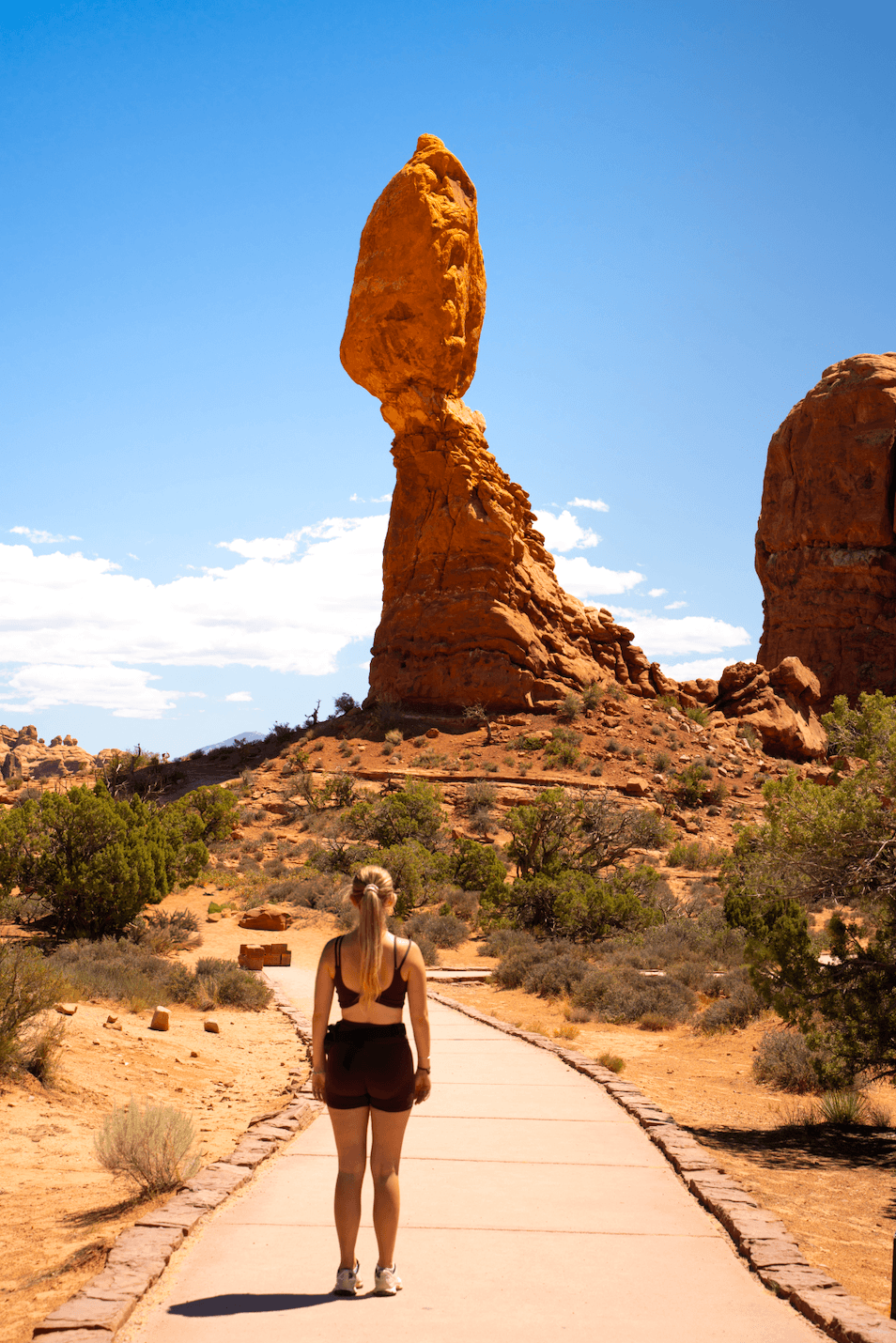
You’ll see Balanced Rock right from the main road as you drive through Arches, but I’d still pull over and walk around it instead of only seeing it through the car window. We stopped here for photos, and getting closer gives you a much better sense of how huge the formation actually is.
There’s a short 0.3-mile trail that loops around the base, so this doesn’t need to take up a big part of your day. It’s an easy stop to fit in between The Windows, Delicate Arch, or wherever else you’re headed next.
Wolfe Ranch & Ute Petroglyphs
If you're already heading toward Delicate Arch, take a few extra minutes to stop at Wolfe Ranch and the nearby Ute petroglyph panel. The historic one-room cabin sits right near the Delicate Arch trailhead, and the petroglyphs are just a short walk away.
The panel shows bighorn sheep and people on horseback, which is one of the clues that some of the images were created by Ute people after horses arrived in the region. It's a quick stop, but I think it's worth seeing because you get a little bit of the history behind this area and a break from arches and rock formations.
Drive the Arches Scenic Drive

Even when we're in Arches mainly to hike, we never end up driving straight from one trailhead to the next. The main road passes places like Park Avenue, Courthouse Towers, Balanced Rock, The Windows turnoff, and several overlooks, so there are plenty of places you'll want to pull over even if they weren't originally on your list.
If you only have a few hours in the park or just don't want to hike all day, I'd still drive the road all the way to Devils Garden and back. You can also download a self-guided audio driving tour if you want a little more context on what you're seeing along the way!
Go Stargazing in Arches National Park
If you're already staying in Arches for sunset, I'd seriously consider sticking around after it gets dark. The park has been designated an International Dark Sky Park, and once you get away from the lights of Moab, the sky can get incredibly dark.
NPS recommends places like Balanced Rock, The Windows, Garden of Eden, and Panorama Point for stargazing. I'd also check the moon phase before your trip if seeing the stars is important to you because the sky will be darkest closer to a new moon.
Take a Guided Tour of Arches National Park
I wouldn't say you need a tour to visit Arches since the park is pretty straightforward to explore on your own. But if you'd rather have someone else handle the driving and planning, there are guided 4WD and sightseeing tours that take you around some of the park's major viewpoints and rock formations.
There are also some really unique ways to experience Arches that you can't do on your own, including scenic flights over the park. Whether you want something easy, adventurous, or just completely different from hiking, I've listed a few Arches National Park tours I'd recommend below:
Arches National Park Sightseeing Tour - Best for First-Time Visitors
Arches National Park Backcountry 4x4 Tour - Best for Adventure
Sunset & Night Photography in Arches National Park - Best for Photographers
Arches National Park Airplane Tour - Most Unique
What to Pack for Arches National Park
What you pack for Arches will depend a little on the time of year, but there are a few things I would bring no matter when you're visiting. The park is extremely exposed, there isn't much shade on most trails, and once you're inside, you won't have restaurants or convenience stores to stop at throughout the day.

Here are a few things I recommend bringing:
Hydration backpack and plenty of water: This is probably the most important thing to bring, especially during summer. A hydration backpack is really convenient for longer hikes because you can carry a lot more water without having to constantly stop and pull out a bottle.
Electrolytes: We almost always bring electrolyte packets with us when we're hiking somewhere hot and exposed like Arches.
Sun protection: Sunscreen, sunglasses, and a good hat are all worth packing. A lightweight sun hoodie is also really nice if you're visiting during the warmer months and want extra protection without constantly reapplying sunscreen.
Good hiking shoes: Some trails involve slickrock, uneven terrain, and scrambling, so I definitely recommend shoes with good grip rather than regular sneakers if you plan on doing the longer hikes.
Comfortable hiking backpack: A small daypack makes it much easier to carry water, snacks, extra layers, camera gear, and everything else you'll need throughout the day.
Headlamp: This is a MUST if you're hiking Delicate Arch for sunset or think there's any chance you'll still be on the trail after dark. We've hiked back after sunset before, and I would not want to do it without one.
Portable charger: Between taking photos, using maps, and navigating throughout the day, your phone battery can disappear pretty quickly.
Layers: Desert temperatures can change a lot once the sun goes down, and mornings can be surprisingly chilly. I always like having a lightweight jacket or extra layer in my backpack.
Offline maps: Cell service can be unreliable, so download your hiking trails and Google Maps before entering the park.
Snacks or lunch: There aren't any restaurants inside Arches, so bring enough food to get you through however long you plan on staying.
Camera gear: Arches is ridiculously photogenic, especially around sunrise and sunset. If photography is a big part of your trip, I'd bring extra batteries and memory cards too.
Things to Know Before Visiting Arches National Park
There are a few things about visiting Arches that are really helpful to know before you get there, especially if it's your first time. Most of these are simple, but they can make your day in the park so much easier.
Arches is open 24 hours a day: You aren't limited to visitor center hours, which is great if you want to enter early for sunrise or stay late for sunset and stargazing, though temporary closures can happen. The visitor center has separate hours that change throughout the year.
Fill up your water before heading into the park: Drinking water is available at the Arches Visitor Center and Devils Garden Campground, but I wouldn't rely on finding water everywhere you stop. NPS recommends planning on about one gallon of water per person per day, especially when it's hot.
Don't rely on cell service: Service throughout Arches can be really spotty, especially around places like The Windows and Devils Garden. Download your Google Maps, hiking trails, and anything else you might need before entering the park.
Arches isn't very dog-friendly: Pets aren't allowed on hiking trails or at overlooks, even if they're being carried. They're generally limited to roads, parking areas, picnic areas, and the campground, so I'd keep that in mind before bringing your dog for the day.
Stay on the designated trails: The dark, crusty-looking soil you'll see throughout the desert is actually biological soil crust, and stepping on it can cause damage that takes years to recover. Stick to marked trails, rock surfaces, and established paths whenever possible.
Check the weather and current conditions before you go: Desert weather can change quickly, and extreme heat can completely change what hikes are realistic that day. I always think it's better to adjust your plans than force a hike just because it was on your itinerary.
Ready to go to Arches National Park?
Did you find these tips helpful? Let us know your Arches National Park plans in the comments! :)
Pin It:


Comments